
Starting an English Cottage Garden on a Budget

Whenever you think of an English cottage garden, of rambling ancient roses and overflowing deep flowerbeds, either colour-themed or in a paintbox palette, the goal to achieve it often seems like a dream just out of reach with the idea that it would take years to complete. Whilst it is true that the older a cottage garden is, the better it generally looks, it is possible to patiently achieve an acceptable cottage garden within just a few years, even on a budget.

The Plants
I have written quite a few blogs on my organic cottage garden, so may I suggest checking them out later? But this blog is different, as I will discuss the sort of plants that are really easy to grow; mostly they all self-seed with ease and need little care, to create the backbone to an English cottage garden. Whilst it is easy to admire a blooming cottage garden, it is rare to consider how much work is involved and in truth, it should all look after itself for most of the year. The biggest secret is to regularly deadhead faded blooms to maintain colourful beds, except for at the end of the season. Once the plants start to slow down their flower production, before the weather changes and the first north winds return, leave all self-seeding flowers to turn to seed. Birds will eat the seeds, such as lupin or snapdragons over winter, returning them to the earth in their poop.
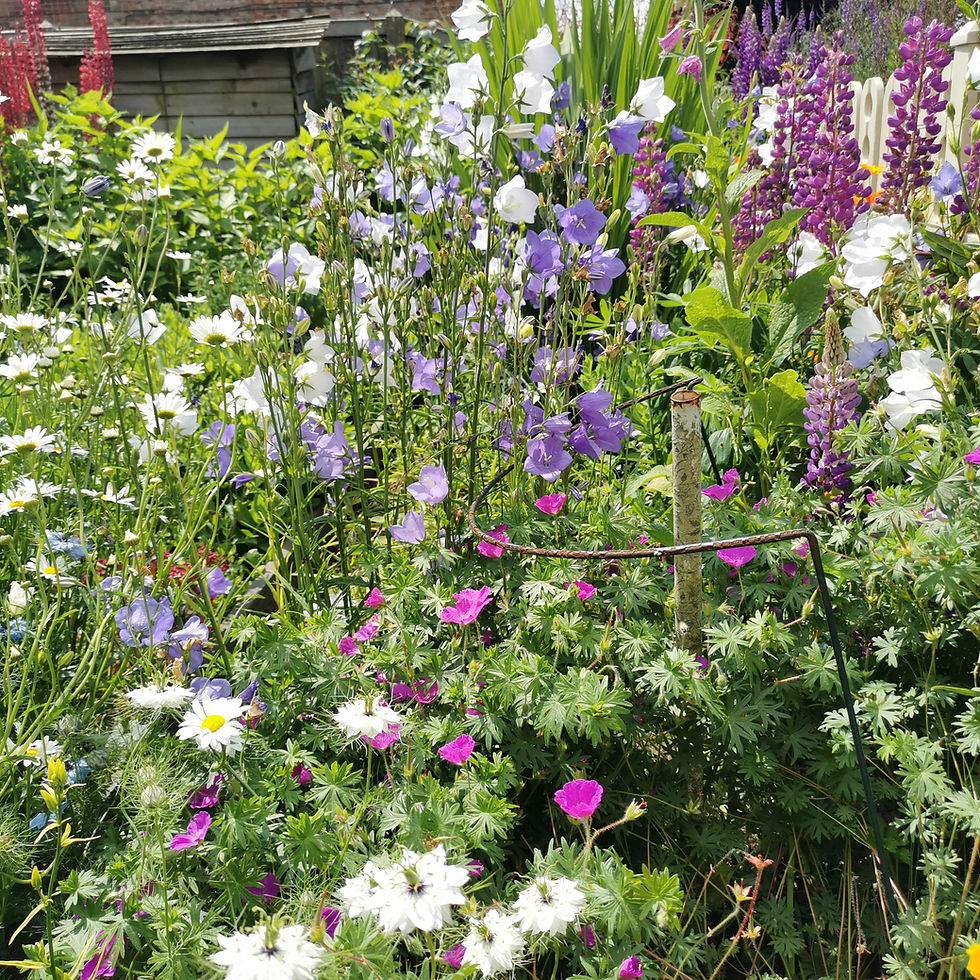
These listed below are all easily grown plants I leave to self-seed in my garden and can be initially grown by directly sowing seeds in October or March:

Pot Marigolds
Nasturtiums
Sunflowers
Cornflowers
Nigella (love-in-a-mist)
Linaria (toadflax)
Flax
Ox-eye Daisy
Harebells
Sweet Williams
Snapdragons
Sweet peas (they do need something to climb up, like a homemade cane teepee)
Lupins (Lupins don't self-seed, but the birds do like the seed pods. I get as many as 3 new lupins a year, just from the birds)
......................................................
These plants are crucial to the aesthetics of an English cottage garden, providing height, structure and shielding screens, but are a little more complicated to reproduce, but easy enough to grow with a bit of care and patience.

Roses (take softwood cuttings in
spring and you'll have a new flowering plant for the following year)
Honeysuckles
Clematis (Softwood cuttings like the roses)
Fuchsias (Softwood cuttings just like the roses)
Delphiniums (divide in spring or a warm autumn, every few years, doubling your plants)
Whilst roses and clematis are up to £20 each, you can get free ones by sharing cuttings with the neighbours. There is loads on the internet on how to take simple cuttings: Take a pencil length of fresh shoot, Use a sharp knife to cut under a leaf joint. Remove all the leaves except for the top pair. Push it into damp soil in a pot. Leave the pot somewhere out of direct sun. Water sparingly to keep the soil barely moist.

Whenever I take cuttings, I always make extra for swopping. It is such a fabulous way to increase the variety in your garden. With today's social media, there are lots of little gardening groups and if there isn't one in your town or village, start one. It is worth the effort for all the extra free plants you can get.
......................................................
Plants for interest that need an extra little bit of well-worth attention:
Hostas (divide like Delphiniums)
Crocosmia (not strictly cottage garden plants, but they are easy bulbs with hot summer colours)
Alliums (self-multiplying bulbs)
Dahlias (Cuttings in Spring)
Cosmos (best sown in a propagator if you're feeling adventurous). You can direct sow, but I've not had much luck with them, so I start mine in the greenhouse or on a windowsill. They are well worth growing, definitely worth the extra time and effort.

Cottage gardens have vegetables and fruits mixed in with the flowers and some plants like purple kale or courgettes have fabulous leaves that look great contrasted against flowering plants.
The Soil
The core secret of any garden is good soil. Without rich, fertile soil, plants will suffer and become stressed, resulting in poor, sickly plants. Soil work is always considered heavy, backbreaking work, but it really doesn't need to be. In spring I collect up to 50 bags of

horse poop from just up the road and let it mature over summer. Fresh horse poop will burn and kill plants, so I let it sit bagged up until autumn. As beds finish around October, I loosen the soil surface whilst doing the last weed/tidy-up of the year, then apply a layer of the collected leaves. The oldies in the village love me dragging a double duvet cover full of raked leaves from local gardens and the fruit orchard next door. Once I've put down leaves, I add a few inches of the horse poop, ensuring plants such as dahlias and roses have an extra shovelful
or two. That's it, done till March. The harshness of winter will rot down the leaves as all the poop goodness washes into the soil.

The Structure
A typical English cottage garden usually looks like a mass of plants battling for space in brimming beds and only on close inspection as you explore do you discover narrow paths between towering, scented spires. Starting a cottage garden, you'll need winding paths leading to little curios; pots can offer some extra height and are especially handy if you

have a greenhouse, as you can have exotic frost-fearing plants that can be moved into the greenhouse for winter. Sunflowers are a great way to create a garden divider. Greenhouses and pots can be expensive, but again, social media has lots of platforms like Facebook Marketplace and Nextdoor where gardening equipment can be cheaply purchased. Trellis up walls is really expensive, so instead drill metal eyes into the wall and thread them with a double length of galvanised garden wire at least 14 or 16 mm for durability. Just one metal eye at plant level and then three eyes in a fan several feet above the first allows you to attach three lengths of wire with just four holes. The double wire allows plants to be threaded in between, rather than faffing with tying up.

With such narrow paths between beds, life is much easier if there is no grass to mow. I did have mower-wide grass paths which looked exquisite when freshly cut with trimmed borders, but the maintenance was time consuming and incredibly boring and quite frankly, life is too short.
This autumn I'll be making a cobbled path from mixed concrete swaddled in clingfilm. Incredibly cheap and easy, mix some concrete, which can be coloured if you fancy something funky, put a dollop on some clingfilm and wrap it up, twisting the excess underneath. Place it on the
prepared path, using bricks or wood to hold the cement parcels where you want them. I plan to experiment by putting patterned texture onto them, for a little added interest. Once the concrete is set, burn off the clingfilm and you'll have a perfect cobbled path for next to nothing.
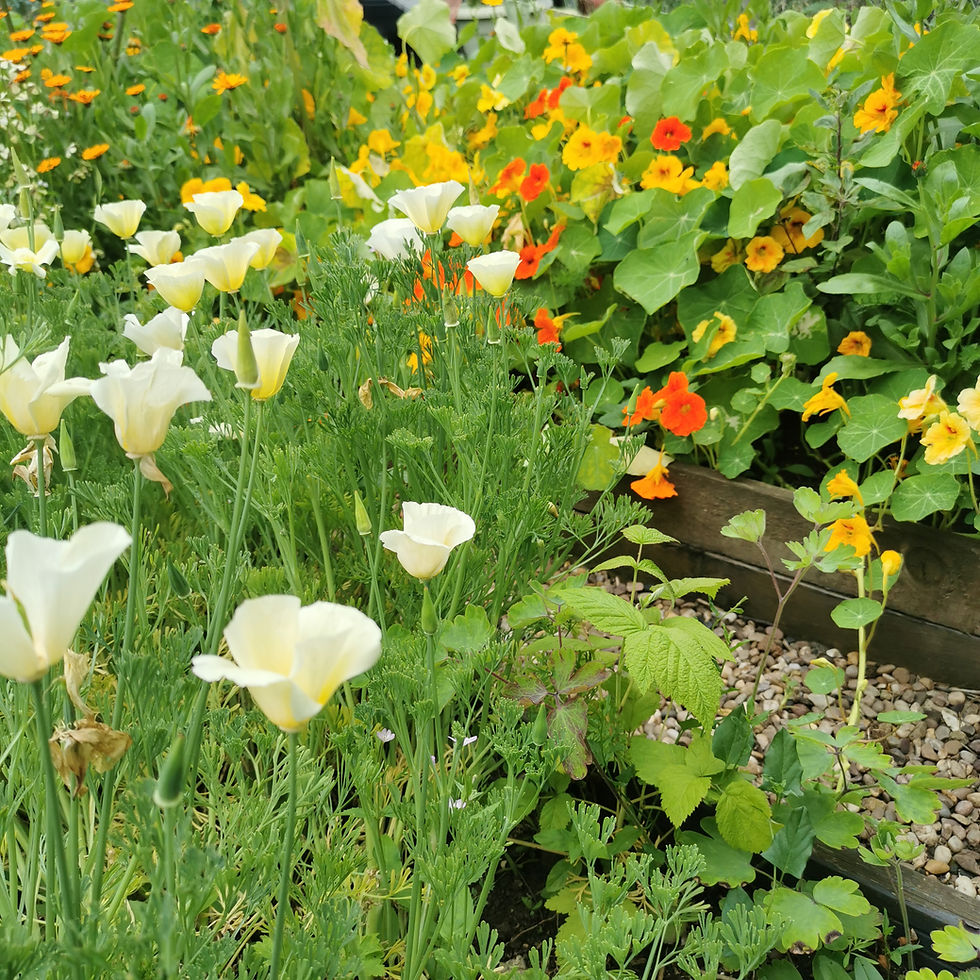
Check out visual research platforms like Pinterest for hundreds of different cottage garden ideas. Collage paths are wonderful, made from all different pebbles, stones, tiles and bricks, thoroughly embracing the principles of a cottage garden. I also saw a brilliant idea where old, wooden front doors, some with glass panels, all painted fabulous colours, were used as a garden divide - quite incredible, so creative.
The Maintenance
In just a few years you'll noticeably have more and more plants and there may come times when self-seeded plants need moving. I rarely move anything but for the odd tiny lupin or snapdragon that might have appeared on a pathway. They are easy to move when they are little, but lupins have huge taproots, so it really takes some digging to lift them out when they are big. Here is a basic guide on what I do and when throughout the year. You'll be surprised how little I do to create the cottage garden in all of these photos.

October/November
Weed the beds and spread poop collected in early spring and autumn orchard leaves.
Prepare for winter storms by tying up and pruning roses.
Sow/scatter any collected seed.
March/April
Weed the beds after winter and prune ready for spring.
Sow/scatter seed.
Collect poop for autumn.
May/August
Deadhead faded blooms and water daily, plus organic liquid fertilizer once a month.
Weed and tidy up.
August/October
Harvest crops and collect seeds. I like to leave the garden to do its own thing in autumn. Birds eat the seeds and spread them as everything closes down.
Themes and Colour Palettes

When I first started out my garden, I didn't consider colour themes too much until my plants had multiplied and I had bought a few bits and bobs, so I had more to work with. This photo above was my first year working towards a cottage garden and just three years later it became this below:

Pastel tulips love-in-a-mist and snapdragons
Below is a fabulous bed of various white flowers accented with blocks of bold colour, with the Sweet Williams tying it all together.

Sculpted lupins Golden pot of marigolds
The two photos above show how effective it is to have just one variety of plant in a bed. Whilst most of my photographs show beds with many different plants, perhaps bonded by a colour theme, the lupins on the left and pot marigolds on the right need no companions to shine.
Good luck with starting your English cottage garden!


Comments