
Sophia Webster Jada Pom Pom Repair

Updated: Aug 1, 2025
It has been another sensational couple of weeks, although it has been grey, dull, cold and overcast for most of July. A few weeks ago I was contacted about some bespoke pom poms. The colour request was no problem; I had the wool for the project, but little did myself or the customer know at the start that there was a bumpy road ahead leading to the ultimate feeling of success. With incredible messages and very clear instructions, this project was a crafter's dream, challenging from the off but resulting in an exact replica of damaged riveted hanging poms. Who would have thought that a little pom not even 3 cm round would have so much time and thought dedicated to it, so much so that it needed recording in this blog?


At the start of the month I had been asked to design a handfasting certificate for a lady, which has already had a lot of interest and straight on the heels of what was until then my favourite design project was another request that would prove to be even more rewarding. I had been asked to make 4 x 2.5 cm pom poms in black and white to replace damaged ones on a pair of shoes. Simple enough, no problem, I was free and could start straight away and they could be in the post that day. However, as I have mentioned, these were not ordinary pom poms. They were on a pair of shoes, held by little eyed rivets threaded over the front. From the photographs and messages, it became clear that these poms were held in by a tiny screw, just 0.5 mm wide; there were no holes to tie the pom to the rivet and it seemed a lost cause as to how the old poms could be unscrewed and the new ones fixed.

Now I know nothing about shoes; I'm still rocking a pair of Vans I bought in 2004 (that's not a typo; it scarily really was 21 years ago!), but I started to think maybe the shoes could be sent to me so I could reverse engineer how the poms worked. Without looking at them, it really was impossible to deduce what could be done. The customer even called the shoemakers to see if they had any ideas, to no avail. I did ask the simplest question that might have answered all our problems. I asked where in the country the shoes were.
Imagine if the lady was in the next town over; it could happen, you never know and I so nearly had a heart palpitation when the reply was 'Seaford.' I couldn't believe it; Sleaford was only 7 miles away. This was incredible; I could go and see the shoes. Problem solved.... Oh, but for that little 'L'! I saw this as a sign, so I became even more determined to find a solution to this pom conundrum.

There was no desperate hurry for these poms, so there was plenty of time to mull and consider different approaches. It became an incredibly personal project to me, as I have always made everything bespoke I have been asked to make; everything has always been a solvable problem. Whenever I get stuck for ideas or need inspiration, I have a mini renaissance and look back historically as to how things were done. One evening when I was dozing off whilst pondering on how to tackle this problem, I imagined how it
would have been solved say 100 years ago.
I imagined that if I had a little haberdasher's shop in Victorian Lincolnshire, probably in a market town like Boston, what would have happened if these shoes had been brought in to be fixed? My first realisation was that back then if you had a thing to mend, you could

walk down the high street and find the right man, or woman, for the job. Today's modern 'throw-away' world relies on messages, photographs, the post office and the internet, where that personal interaction with crafters has been lost. This is another reason why this pom project has had such an impact: it was like going back 100 years, where bespoke customer service was part of the shopping experience, which is something I always try to achieve with my Etsy shop, with the difference here being the customer was
working with me and together we solved the problem, as if we had been chatting over a beeswaxed crafter's table in a little haberdasher's shop. As someone who always buys second hand over new because most mass-produced things are built not to last but to be replaced and thrown away, was yet another reason why fixing these little poms was so important.

Someone reading this may consider the subject matter on the boring side of dull, but the underline story is that this was a request that needed solving, irrelevant whether the order was for 1 or 100 poms and the same amount of time would be dedicated to either. It is another reason I started my Etsy and bespoke commissions are my favourite thing to do, especially when the customer has clear instructions and responds promptly to my queries and ideas. After a week or so of discussion and messages, the customer had a great
idea. The rivet-hung poms were to be sent through the post and I on receipt I set to work trying to figure out how they were constructed.
Having repeatedly picked them up for study throughout the day, I slept on it overnight, as this was not a task to be rushed. I had learnt that the shoes were vintage Sophia Webster Jada Pom Pom slides and no longer available, so the pressure was on to find a way to fit the new poms to the same standard as the originals! It was fortunate that my husband has every size hex screwdriver there is and once he had loosened the tiny, tiny screw, the pom could be teased out. It had been threaded to a little stub of foam, which was held in place with the screw.
At this point I realised these were high-quality shoes and no doubt very expensive with such an elaborate pom mechanism. I made the poms and only trimmed part of them, making sure the two ties were at the same place so they could be repeatedly knotted together to form a replacement for the foam nub. I carefully put some PVA glue into the rivet so the wool knots could be pushed into it,

making them rigid like the foam once the glue had dried. I didn't put the glue on the wool knots, as I was trying to avoid getting the pom all sticky. Once they were screwed back into place, they were ready for a final trim. Once attached and finished, they were perfect, secure, firm and a real achievement. I had kept in contact with the customer throughout, sending her the progress photos featured in this blog. (Progress photos are a little rougher than a product photo such as those featured on an e-commerce listing,
as they are meant to be a behind-the-scenes
view of how things are coming along), but I didn't send a photo of the finished pom, as I wanted it to be a surprise, equal to my elation at the success of this project. It was to be a complete shopping experience like those of old, exquisitely packed and wrapped with the same care and quality as the pom making itself, leading to curiosity, excitement and anticipation as the parcel is unpacked.
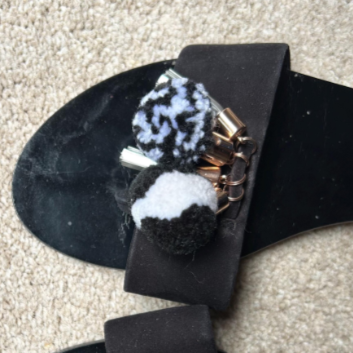
[I have permission to use the photographs of the shoes as they are not mine]


Comments